

Modernizing BSH Germany’s Product Information Management with AWS Managed Services
BSH Germany
About the customer
B/S/H Hausgeräte GmbH (German for ‘B/S/H Home Appliances’, stylized as B/S/H/) is a Munich-based global manufacturer of home appliances and related digital services, and it positions itself as a leading company in the home appliance industry. Operating in the consumer durables / “white goods” manufacturing sector, it serves households with product categories that include cooking and baking, dishwashing, cooling and freezing, washing and drying, and small appliances. B/S/H says its portfolio ranges from large appliances to cooktops, ovens, ventilation hoods, dishwashers, washers, dryers, fridges, and freezers to small appliances such as vacuum cleaners, espresso machines, and kitchen machines. It sells these products through a multi-brand strategy that includes global brands like Bosch, Siemens, and Gaggenau, plus regional brands such as Neff and Thermador (alongside additional local brands in some markets). The company is part of the Bosch Group and notes that it is a trademark licensee of Robert Bosch GmbH for the Bosch brand and Siemens AG for the Siemens brand. For 2024, B/S/H reported turnover of about €15.3 billion and more than 57,000 employees. Its industrial footprint spans 39 factories, and the group says it is represented in around 50 countries. Alongside hardware, B/S/H emphasizes software-enabled experiences via Home Connect, an ecosystem that connects appliances from multiple B/S/H brands to digital services in a single app. Home Connect supports remote control and automation and can work through voice assistants like Amazon Alexa or Google Home. In industry terms, B/S/H competes with other major home-appliance manufacturers in a market where energy efficiency, design, reliability, after-sales service, and smart-home integration are key differentiators. On its corporate site, B/S/H frames its mission as improving quality of life at home worldwide by staying close to consumer needs and continuously innovating across its brands. Overall, it sits at the intersection of industrial manufacturing and digital consumer technology, supplying branded appliances and connected services to households around the world.
Customer Challenge
As a global manufacturer operating across dozens of countries, B/S/H needed to modernize its Product Information Management (PIM) capabilities to support consistent, real-time access to product and catalog data across multiple channels. The existing approach was not sufficient to handle increasing volumes of product updates, multilingual content requirements, and simultaneous API requests coming from corporate websites and third-party systems. To enable scalable digital commerce and seamless integrations, B/S/H required a high-performance, API-driven architecture that could process frequent product changes while delivering fast and reliable responses globally.
If this challenge had not been addressed, the business impact could have been significant. Outdated or inconsistent product information across regions and platforms would directly affect customer experience and trust, potentially leading to incorrect purchasing decisions and lost revenue. At the same time, performance bottlenecks or system instability under high traffic could disrupt critical digital channels, especially during peak demand periods. Without a scalable and resilient foundation, B/S/H would also face limitations in expanding its digital services, increasing operational overhead, and maintaining competitive positioning in a market where accurate and fast product information is essential.
Partner Solution
How Commencis solved the customer challenge
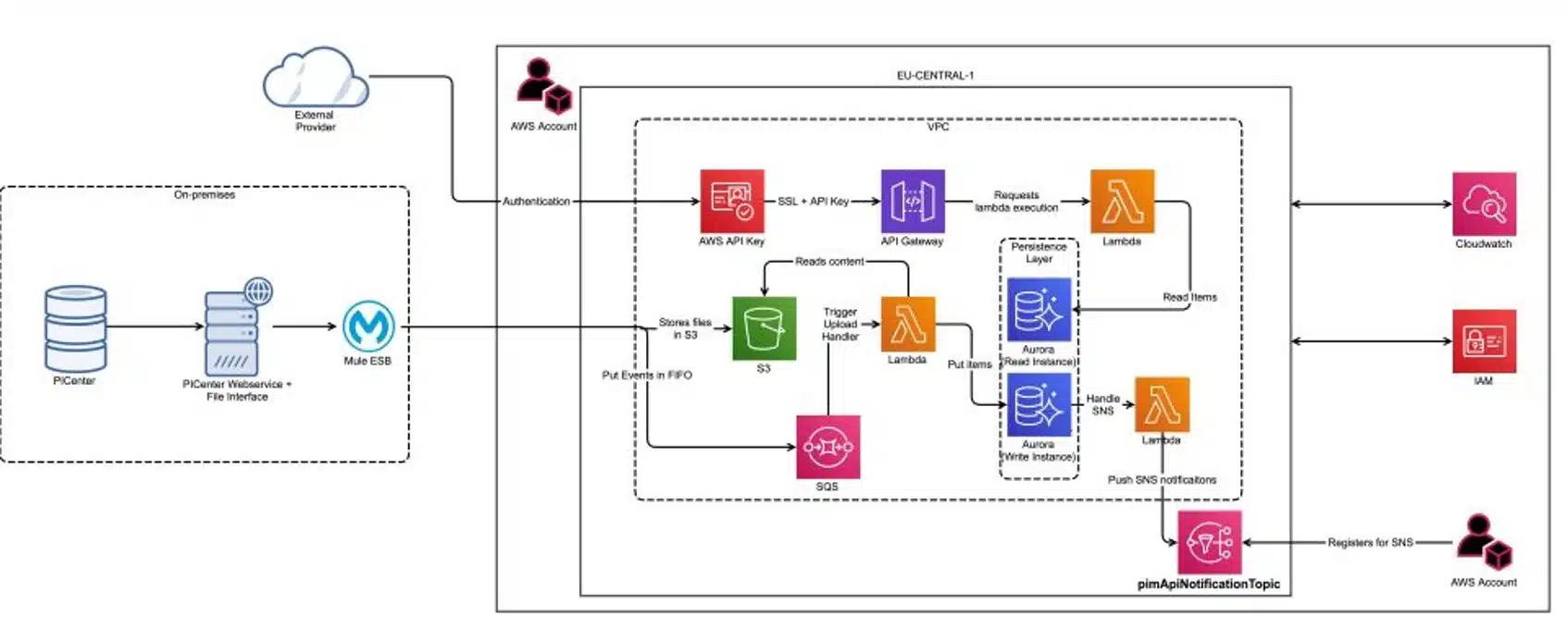
Commencis Cloud Team, addressed B/S/H’s challenge by designing and implementing a fully decoupled, event-driven PIM architecture on AWS that separates data ingestion from data consumption, ensuring both scalability and high performance. Product data changes generated in on-premises systems were asynchronously transferred to AWS through S3 and SQS, where serverless Lambda functions handled parsing, transformation, and persistence into an Aurora PostgreSQL database. This approach eliminated tight dependencies between systems and enabled reliable processing of continuous product updates without impacting upstream or downstream applications. By introducing this asynchronous pipeline, the solution ensured that even during peak loads or maintenance scenarios, data ingestion and processing would continue without interruption.
On the consumption side, Commencis implemented API-driven services using API Gateway and Lambda to provide secure, high-performance access to up-to-date product data. Read operations were offloaded to Aurora read replicas, significantly improving response times and enabling the system to handle thousands of concurrent API requests. Additionally, SNS-based notifications ensured that downstream systems remained synchronized by reacting to real-time data changes. Combined with performance testing and infrastructure automation, this architecture provided B/S/H with a resilient, scalable, and globally accessible PIM platform capable of meeting strict latency and throughput requirements.
AWS Services used as part of the solution
The solution was designed on a serverless and event-driven AWS architecture to ensure high scalability, resilience, and minimal operational effort. AWS Lambda acted as the core compute layer, handling both data ingestion and API workloads dynamically based on demand. Product data generated from on-premises systems was first stored in Amazon S3, while Amazon SQS provided a reliable buffering and decoupling mechanism between systems. This ensured that incoming product updates could be processed asynchronously without impacting upstream systems, even during peak loads or temporary downstream issues. By leveraging this pattern, Commencis enabled a fault-tolerant pipeline where data could be ingested, processed, and persisted consistently without bottlenecks.
For data storage and access, Amazon Aurora PostgreSQL was implemented with a clear separation between write and read operations, using a primary instance for transactional updates and read replicas to serve high-volume API queries with low latency. Amazon API Gateway provided a secure and scalable interface for exposing product data services, while Amazon SNS enabled real-time event notifications to keep downstream systems synchronized. The entire platform was delivered using Infrastructure as Code with Terraform, supported by CI/CD processes in GitHub and validated through performance testing with JMeter. This approach ensured a consistent, production-ready deployment that could meet strict performance requirements while supporting B/S/H’s global scale.
Third party applications or solutions used
Beyond AWS native services, the solution was strengthened with well-integrated third-party tools to ensure disciplined delivery and operational consistency. GitHub served as the central platform for source code management and release processes, enabling structured CI/CD practices, environment-specific deployments, and full traceability across changes. In parallel, Terraform was used as the Infrastructure as Code layer to define and provision all AWS resources in a consistent, repeatable manner, reducing manual effort and eliminating configuration drift. From a performance perspective, JMeter was used to simulate high-concurrency scenarios and realistic API traffic patterns, allowing the team to identify bottlenecks early and optimize the system before production. Together, these tools established a robust and reliable delivery pipeline, ensuring the platform met both scalability and real-world performance expectations.
Commencis Support Services During Pre and Post Implementation of the Solution
Commencis supported B/S/H throughout the entire journey, from early design decisions to post-production operations, ensuring the solution was not only delivered successfully but also remained reliable over time. In the early stages, the team worked closely with stakeholders to shape the architecture, validate performance expectations, and design a scalable, event-driven AWS setup that could handle real-world demand. They also put the right foundations in place with Terraform for consistent deployments and used JMeter to test how the system would behave under load before going live. During implementation, Commencis handled the development and rollout of the serverless components, integrated everything with existing on-premises systems, and established CI/CD processes through GitHub to make deployments controlled and repeatable. After go live, their role continued with hands-on support, providing 7/24 monitoring with Datadog and AWS Cloudwatch, and operational support, proactively optimizing performance, managing incidents when needed, and guiding continuous improvements ensuring the platform remained stable, responsive, and fully aligned with B/S/H’s growth and evolving requirements without disruption.
Results and Benefits
Architectural Diagram
Benefits of the Solution
The new architecture delivered significant, measurable gains in both performance and scalability. By adopting a serverless and event-driven design, B/S/H was able to handle up to 5,000 concurrent API requests per second while consistently meeting strict latency targets (P50 < 200 ms, P95 < 500 ms). Compared to the legacy setup, response times improved by up to 10x, which had a direct impact on end-user experience across digital channels such as e-commerce platforms. In addition, the use of SQS and Lambda for asynchronous processing eliminated ingestion bottlenecks and ensured continuous data flow even during peak loads or maintenance windows, effectively increasing system availability and resilience while reducing operational interruptions.
From an efficiency and cost perspective, the shift to AWS introduced a much more optimized and flexible operating model. With on-demand scaling and fully managed services, B/S/H reduced the need for over-provisioned infrastructure, leading to an estimated 30-40% cost optimization. At the same time, operational overhead was significantly reduced by roughly 60% as tasks such as scaling, patching, and failure handling became automated. The separation of read and write workloads in Aurora further improved database performance and resource efficiency, while the event-driven notification model reduced unnecessary system interactions, enabling faster synchronization with lower compute and network usage.
Client Case Studies
We deliver solutions using our extensive knowledge and more than 10 years of cloud transformation experience.

AWS Redshift Transforms BSH’s Data Management Efficiency
AWS Redshift and associated services transformed BSH's data management, enhancing operational efficiency, decision-making, and global strategic initiatives,…

Faladdin Implements AWS CloudFront for Mobile Deployment
By leveraging AWS Cloudfront, AI based app Faladdin with more than 25 million downloads, successfully deployed its mobile backend applications to the cloud…

San TSG Streamlines SaaS Deployment with AWS CloudFront
Leveraging various AWS services including AWS Cloudfront, SAN TSG has significantly improved its infrastructure, enhancing operational efficiency and client…
BSH Transforms Product Data Management with AWS
BSH implements AWS CloudFront via AWS API Gateway for global access, minimizing delays from remote connections.

San TSG Enhances Operational Excellence with AWS
SAN TSG ensured data integrity, high availability, streamlined API management, reinforced security, and integrated powerful search functionalities, all…
