

Transforming after-sales service quality control with multimodal GenAI on AWS
Commencis built Kâhin, a human-guided quality-control platform combining generative AI, deterministic business rules, multimodal analysis, and AWS serverless services to evaluate more than 250,000 after-sales service tickets every month.
Vestel
ABOUT THE CUSTOMER
Vestel
Vestel is one of Europe’s largest consumer electronics and home appliance manufacturers, producing televisions, white goods, and digital products at scale for both its own brands and for global partners.
Alongside manufacturing, Vestel operates an extensive after-sales service network. Every month, this network generates more than 250,000 service tickets containing technician notes, fault and resolution descriptions, parts and labor records, images, videos, documents, and structured business data. Each of these records must be reviewed before critical operational and financial processes can be completed.
THE CHALLENGE
Scaling quality control across a high-volume service operation
Vestel needed to evaluate a large and diverse flow of service tickets before completing critical operational and financial processes. The information required for each decision was distributed across structured fields, technician explanations, service actions, visual evidence, and supporting documents.
The applicable criteria also varied by product group, operation type, and evaluation phase. Scaling the manual process would have required additional review capacity while increasing the risk of delayed decisions, inconsistent evaluations, and limited operational visibility.
PARTNER SOLUTION
A human-guided multimodal GenAI platform built on AWS
Commencis worked with Vestel to build Kâhin: an enterprise generative AI platform on AWS that combines deterministic controls, contextual AI reasoning, multimodal evidence analysis, and human review within one auditable decision workflow.
Configurable rules handle exact business conditions, while generative AI evaluates only the cases that require semantic or contextual understanding. Eligible tickets follow automated paths; uncertain or higher-impact cases are routed to reviewers together with the source evidence and AI-generated findings. Every decision — criteria applied, findings produced, reviewer actions, overrides, and final outcome — is recorded, so decision quality itself becomes measurable.
Hybrid rules and AI
Deterministic rules resolve exact business conditions; generative AI is invoked only where interpretation is genuinely needed, controlling inference cost.
Multimodal understanding
Text, images, video, documents, and structured ticket data are evaluated together to build a complete view of each service record. Amazon Titan Embeddings and Amazon S3 Vectors identify duplicate or reused media across tickets.
Human-guided decisions
Reviewers stay in control of exceptional, uncertain, and business-critical cases, supported by structured evidence and AI findings that shorten each evaluation.
Serverless Scale & Cost Efficiency
Scales processing components independently with ticket and media demand while using a serverless, consumption-based architecture to minimize infrastructure overhead and optimize AI inference costs.
Cloud Architecture
Serverless, event-driven, and designed for enterprise-scale AI operations
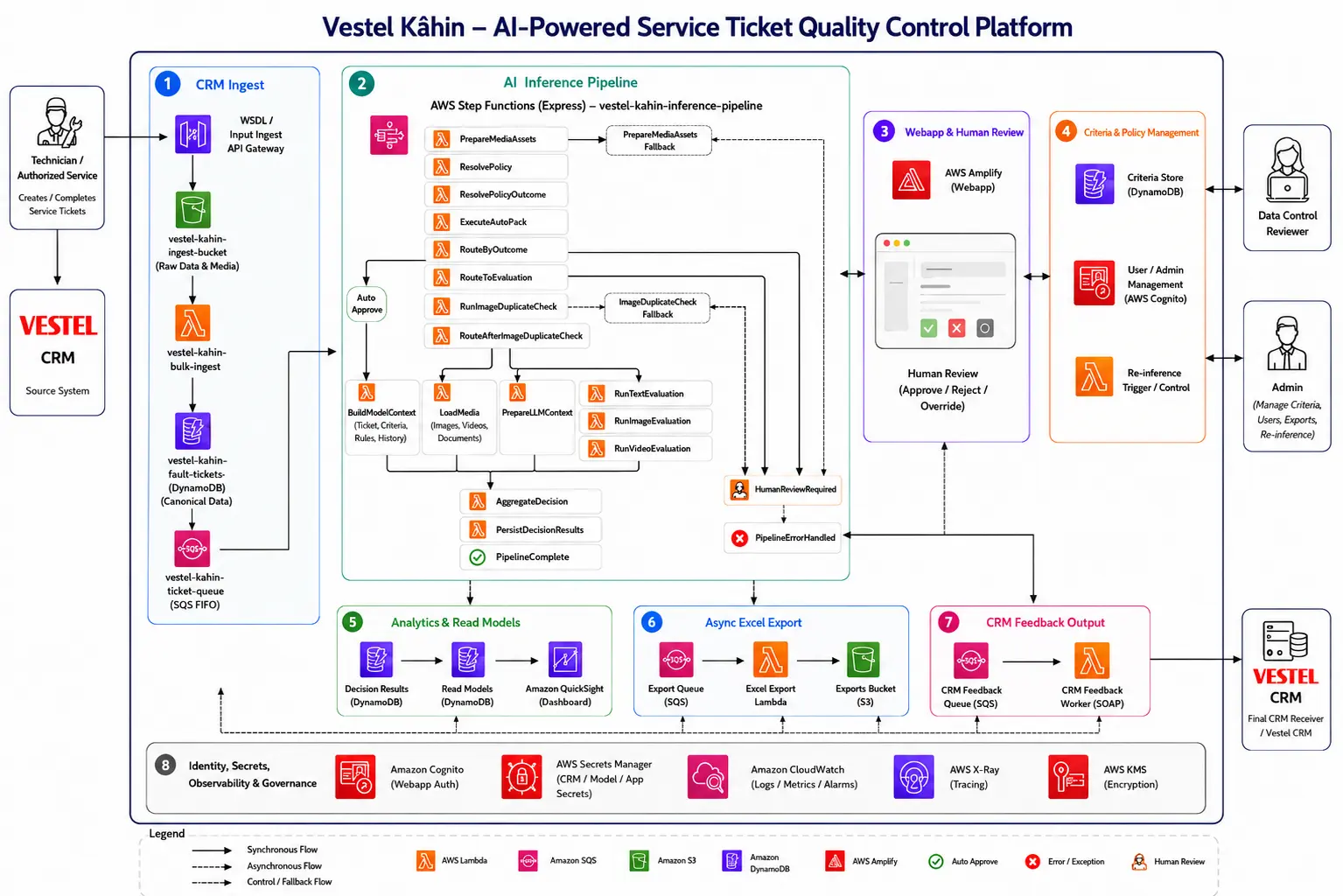
Commencis designed Kâhin as an operational AI platform rather than a standalone model integration. The architecture separates ingestion, evaluation, human review, analytics, exports, and CRM feedback so that each workload can scale independently and remain observable.
Preserving source data while creating a reliable processing pipeline
Service tickets and media are received from Vestel CRM, normalized into a consistent structure, and preserved in Amazon S3 for traceability. AWS Lambda handles transformation, Amazon SQS buffers demand, and Amazon DynamoDB stores canonical tickets and operational state.
Combining rules, text intelligence, and multimodal evaluation
AWS Step Functions coordinates policy resolution, deterministic rule execution, image duplication checks, text evaluation, image and video analysis, decision aggregation, retry handling, and fallback paths. Amazon Bedrock provides managed access to foundation models for semantic and multimodal reasoning.
Keeping people in control of business-critical decisions
A secure web application presents the original ticket, applied criteria, supporting evidence, AI findings, and decision rationale. Amazon Cognito provides identity and role-based access, while reviewer actions and overrides are retained for auditability and performance analysis.
Returning decisions to CRM without slowing the evaluation pipeline
Final outcomes are delivered through a separate asynchronous CRM feedback flow, protecting the main evaluation process from external system latency. Amazon CloudWatch, AWS X-Ray, AWS Secrets Manager, and AWS KMS support monitoring, tracing, security, and operational governance.
Business Impact
One clear view of measurable value
The platform combines high automation, faster validation, and controlled unit economics at enterprise scale.
Outcomes & Benefits
Higher automation. Lower unit cost. Faster review.
Focus people where they add the most value
Automating eligible quality checks enables review teams to focus on complex, ambiguous, and higher-impact service cases rather than repeatable verification work.
Accelerate human validation
Structured evidence and AI-generated findings help reviewers complete selected evaluations in approximately 25–45 seconds, releasing more than 384 hours of review capacity every month.
Keep enterprise GenAI cost measurable
A serverless, usage-based AWS architecture with selective model use delivers an indicative processing cost of approximately USD 0.0076 per ticket, keeping AI spend predictable as volumes grow.
Make decisions auditable and improvable
Criteria, findings, reviewer actions, overrides, and outcomes are recorded for every ticket, giving Vestel visibility into decision quality and a feedback loop for refining evaluation policies.
