Commencis Talks: New Forms, New Interactions: Beyond the Interface
Reading Time: 7 minutes

Tuğba Erdem
Design Manager
Last year, a significant update for design was announced to the tech industry: Apple’s legendary designer Jony Ive and his team joined forces with OpenAI. OpenAI’s potential shift toward an AI-powered device-level interaction signaled a certain direction and sharpened a topic I’ve been questioning: Is interaction drifting beyond screen-focused paradigms? Moreover, when AI makes the interface less visible, how do business value and design change?
To me, two forces are pulling in opposite directions: One focuses on operational leverage for the business, where AI workflows promise speed, efficiency, and risk control. The other focuses on maintaining trust, consistency, and user control in increasingly “intelligent” systems. With this tension in mind, I aim to provide a thoughtful response through a constructive discussion by leading the conversation with our panelists from Commencis Talks, Designer Founder Yakup Bayrak, and our CEO Fırat İşbecer.
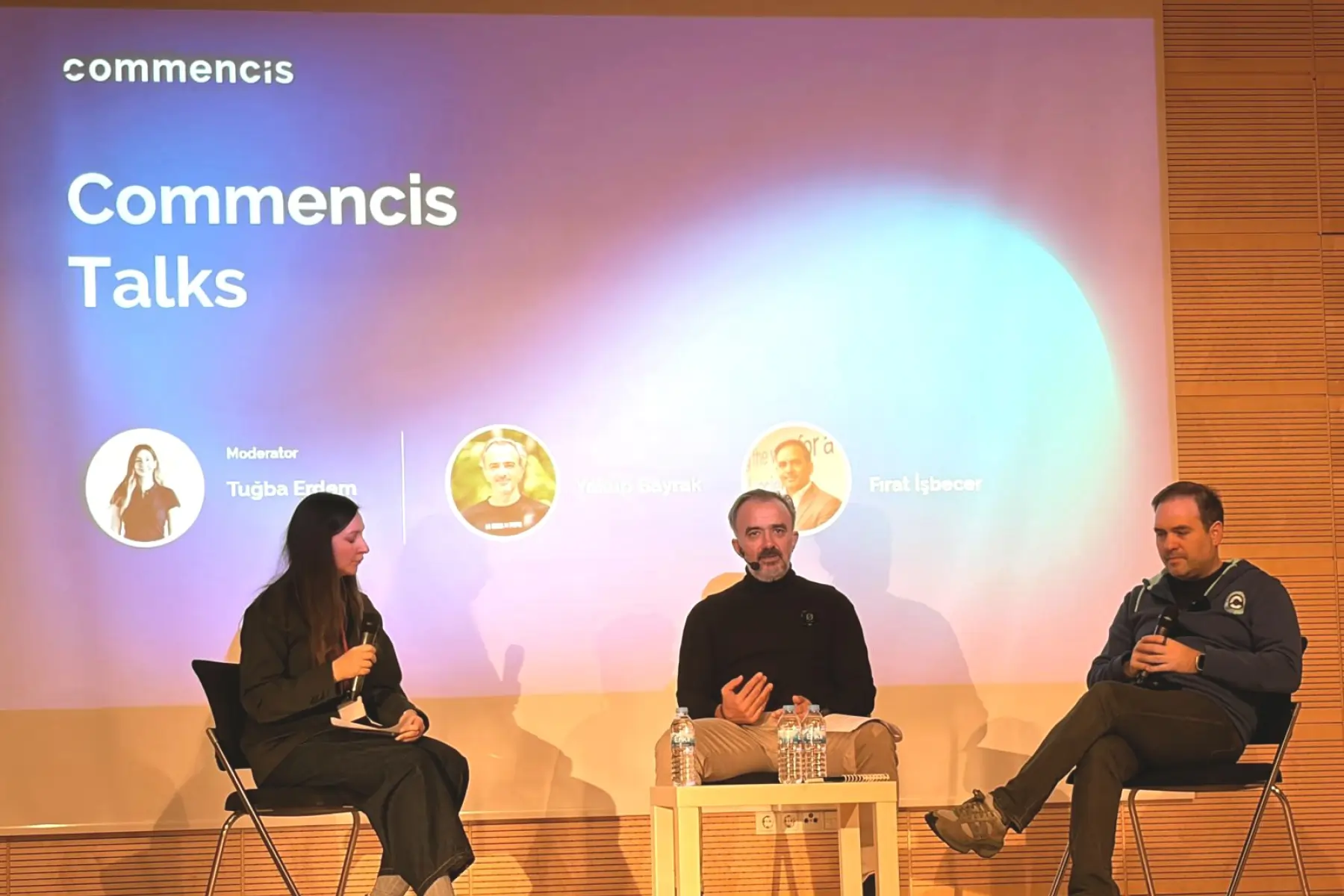
Commencis Talks panel with moderator Tuğba Erdem, Designer Founder Yakup Bayrak, and CEO Fırat İşbecer, discussing the future of interaction design and AI.
Changes in business goals: Agentic experiences, automation, and responsibility
This initial part of our discussion covered agentic experiences, emphasizing how business progress has evolved and how automation enables AI to make decisions across companies. We aimed to answer: Where does value creation happen, and what is the core business problem we aim to solve with AI? Should businesses prioritize improving internal operations or developing customer-facing AI-assisted product innovations? Where should we keep the human-in-the-loop mechanism?
When considering AI’s placement, we believe it is neither just a polished feature showcased in the product nor solely about saving time in daily operations. While both add value, it’s important to carefully decide where and how to leverage AI effectively.

Yakup Bayrak presents his perspective on design thinking and communication at Commencis Talks.
Finding the Right Pace for AI Adoption
FOMO is real, but understanding the current state and planning the next step is essential for businesses and technologists alike. Asking, “What did I do today for AI?” can serve as a guiding mantra to stay updated, lead teams, and serve customers better. People in tech move quickly, often outpacing others, but moving too fast risks losing context and deploying solutions more advanced than necessary. To stay aligned, we should avoid being too far ahead of the adoption curve.
Furthermore, this isn’t a new coding approach focusing on technical prompting details. We must recognize that generative AI is about agentic orchestration, not just prompting. A single intent can replace multiple fragmented journeys. For example, consider the task of “planning a vacation,” involving various businesses and products like flights, hotels, car rentals, and museum tickets. With agentic orchestration, the focus shifts from asking “how to craft better prompts for optimal planning” to designing key decision points that incorporate all relevant businesses and products. This involves understanding the context, asking the right questions, and presenting options effectively, enabling users to make better decisions.
The role of design in new forms of interaction: Decision moments, new touchpoints, and consistency
As the conversation progressed, we introduced a more design-centric perspective, noting that as businesses grow and adapt to AI, the unique value proposition may change, but the focus remains on the user experience, albeit in a new form. The outputs and, therefore, the outcomes that the design aims to achieve also change. In other words, our questions here are: What do designers create moving forward? What do guardrails and policies imply for design? How do new touchpoints and new forms of interaction contribute, along with concerns about consistency? Haven’t we recently addressed this with design systems? What additional components do we need?
Alongside changes in AI value propositions, we recognized that the role of designers is also evolving. This shift moves from designing screens to designing decision moments, where context, options, and the right level of user agency are key components. In recent years, design has also been at the table for a systematic approach, designing sustainable systems, which happen to have interface reflections. The job now involves designing systems and flows that account for multiple touchpoints across products and services.
Therefore, we designers will most likely position ourselves as – what I call – “decision architects,” considering agentic capabilities, users’ intentions, and business goals across multiple touchpoints in new forms of interaction. The design surface becomes the architecture of intent, confirmation, and consequence. Decision moments should become intentionally and thoughtfully informative, without being overloaded, so users feel in control.
Our emphasis on new forms of “interactions” rather than “new forms” yields “new contexts” that empower users to undertake new user jobs they never imagined before. The form is irrelevant, but the technology capability is important. With AI advancements, resistance to new forms of interaction is at its lowest; each new product or service that introduces innovative and intelligent interactions will easily persuade users, thereby gaining a competitive advantage.

Commencis Talks attendees following the panel discussion on AI, interaction design, and the future of digital experiences.
What Comes Next: Hyper-Personalization and Voice
Will proactive, hyper-personalized, and dynamic interfaces be the next hype? That is not certain. However, data and analytics capabilities are required and are being developed. This will certainly enable the uncovering of intent and the proactive initiation of engagement from the system to the user. That future is not too far away. AI-powered IVR agents have already begun guiding users; conversations started with data that helps users find relevant information, and BI tools that synthesize sentiment-based insights are expanding.
We discussed a clear impact with an expected increase in voice interactions, which will influence conversation design. Current AI solutions mainly focus on AI-assisted, voice-enabled chatbots and agents to create a more human-like user experience.
However, a clear “bot contract” is necessary to distinguish between a computer and a human. Human-in-the-loop systems will be essential in the future, and managing differences throughout the process is important to set proper expectations. A voice-enabled bot is not a replacement for the user interface, but it is a crucial element in interaction design. For example, using the camera feature of such an AI-assisted bot to display when the washing machine fails and to receive verbal guidance on how to fix it can reduce contact points, such as calling a service technician. This will accelerate the adoption of omnichannel voice experiences.
Key takeaways for utilizing AI: Guardrails & trade-offs
Our aim with this panel was to provide our audience with key takeaways that serve as guiding principles, integrating business needs and design outcomes as a unified approach. We explored trade-offs like trust and speed, autonomy and human oversight, and transparency and opacity to define how decisions should be shaped going forward. Here are the key principles we believe in and agreed on that can serve as red lines for AI:
First, and most importantly, we believe that AI should never execute irreversible operations on its own. The control and final decision point for the user should be presented as critical actions, such as financial decisions or transfers.
With great power comes great responsibility. Offering an “undo” action is non-negotiable. It is closely linked to the concept of the algorithm’s transparency and how it operates.
Silent automation is not the goal; transparency about the process reveals the path taken. What matters is clear outcomes. Including a watermark on any AI-generated content is critical for users to verify the accuracy of the information provided.
Concealing errors undermines trust. No one wants to interact with an agent that would not say what it did. The day’s best summary was one word: control. Critical decisions should stay with the user.
Hyper-personalization is rising. Even if consistency is crucial for the scalability and sustainability of design as a system, a system that treats every user “equally” can still be perceived as impersonal.
Given Turkey’s unique ecosystem, the strong momentum behind mobile banking and fintech over the past decade indicates increased adoption of AI-assisted solutions in the coming years. However, there is still room for development, particularly in on-premises and cloud-based AI solutions, data privacy, and, of course, ethics and human-centeredness of design.
FAQ
Agentic AI creates value in both areas, but the key is identifying where it solves your core business problem first, then placing the human-in-the-loop accordingly. Pace matters: FOMO is real, but moving too far ahead of adoption can backfire. A simple habit like asking “What did I do today for AI?” helps teams learn continuously without overreaching.
In AI-driven UX design, a decision architect shapes the critical moments where context, options, and user agency come together. Instead of crafting isolated screens, designers shape the architecture of intent, confirmation, and consequence across multiple touchpoints. Guardrails and policies become core design components, keeping users informed and in control.
Conversational AI and voice interactions work best when users clearly understand they’re engaging with a bot and know its boundaries. Voice augments rather than replace the UI — it’s one element in an omnichannel experience. Keeping a human in the loop and setting expectations transparently is what makes it work.
Responsible AI design starts with a few non-negotiables: AI should never execute irreversible actions on its own; an undo option is a must, and errors should never be hidden. Processes should be transparent, AI-generated content should be watermarked, and critical decisions should always stay with the user.
Reading Time: 7 minutes
Don’t miss out the latestCommencis Thoughts and News.
Tuğba Erdem
Design Manager